






EdTech to Inclusion Education: Lowering the Accessibility Divid
Technology is transformational in the current changing educational environment. EdTech (Educational Technology) has presented unmatched possibilities to students all over the world including those who experience a hindrance because of disability, socioeconomic factors, or being in isolated locations. Inclusive education is ceasing to be an idea–it is turning into a viable reality, due to innovations that eliminate accessibility gaps, as well as promote equal learning opportunities.
Learning about Inclusive Education in the Digital Age.
The idea of inclusive education concerns equal opportunities of learning for every student, irrespective of physical, cognitive, or social differences. Conventional classrooms usually have difficulties in meeting various learning requirements, including those with visual or hearing disability, those with learning disability. EdTech can help with these issues by providing adaptive learning devices, assistive devices, and personal learning.
As an illustration, speech-to-text and screen readers can be used to allow students with visual impairments to understand the content. Equally, videos and live translation devices are enabled through closed-captioning, which serves the needs of students with hearing disabilities or language barriers. Through such tools, teachers can provide lessons that can accommodate all the learners.
Accessibility Leading Tools of EdTech.
Learning Platforms Adaptive.
The adaptive learning platforms are AI-based and data-driven, learning applications that tailor lessons to individual student achievement and strengths. Such platforms will be able to determine the areas where students are not performing well and give them personalized content or tasks so they do not leave the rest of the students behind.
Assistive Technologies
Assistive technologies refer to a wide spectrum of tools and applications that aid the disabled. These aids, including braille projectors in blind students, specialized keyboards in students with motor difficulties, etc., make the process of learning more inclusive and accessible.
Web-based Classrooms and Distance Learning.
Accessibility has been metamorphosed by virtual classrooms. Remote students or students who cannot attend physical classrooms because of their health conditions now have access to live classes, do assignments online, and interact with their colleagues remotely. Such sites may feature accessibility control (e.g. font adjustments, screen readers, simple navigation control).
Interactive Content and Gamification.
Interactive content and gamified learning can support the needs of various learning styles and will improve the experience of children with cognitive or attention-related issues. EdTech also makes learning effective to all people, no matter their capabilities because it incorporates visual, auditory and kinesthetic senses.
Technologic empowerment of teachers.
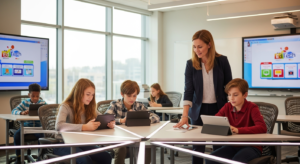
EdTech does not only prove useful to students, it also empowers teachers. The learning management systems, real-time analysis, artificial intelligence-based grading, and others can assist educators to track and evaluate individual progress, detect gaps and offer specific assistance. Professional development platforms provide courses in strategies of accessibility and inclusion, so that the educators are ready to use technology to benefit themselves.
With the help of these tools in conjunction with classical teaching knowledge, a teacher is able to develop an individualized learning experience that can focus on both the strengths, as well as weaknesses of the student in order to make them more engaged and successful in the academic growth.
The Implication of EdTech on Inclusion Education.
EdTech is a tool and also a bridge, which narrows the gap of inequality in education. Research indicates that students with easy access to the technology perform better with increased participation, retention, as well as confidence. Inclusive EdTech is also able to create a sense of belonging by making students feel empowered to take part in the learning process.
In addition, teachers also have access to real-time insights and analytics to inform the teaching methods. Such a data-based solution will make sure that interventions are timely and effective, which will further bridge the access gap in education.
Problems and Future Outlook.
Although EdTech could be very powerful, there are issues. The barrier to implementation can be limited access to high-speed internet, the expensive nature of assistive devices, and insufficient training of teachers. It is necessary to tackle those issues with governmental assistance, the cooperation between government and the corporate sector, and specific professional development courses.
In the future, the use of AI and AR/VR, as well as cloud-based solutions, is likely to make inclusive education even easier. Automation of content translation tools, creating an immersive learning process, and personalizing learning needs will close the gaps and lead to a genuinely fair educational context.
Conclusion – Towards a Fully Inclusive Future.
The quest to achieve inclusive education is in progress, yet EdTech is a strong companion in ensuring that it is a reality. The barriers that are historically disabling students to meaningful education can be disaggregated by combining adaptive technologies, assistive devices, virtual learning, and the support of teachers.
Along with providing students with disabilities with an equal learning opportunity, inclusive education promotes diversity, empathy, and teamwork in the classroom. With the ever-changing technology, there is an urgent need to ensure the collaboration between educators, policymakers, and technology developers where accessibility and equity are at the center stage of the innovation.
The future of education is not only digital but inclusive, personalized and available to all learners including the ones who face challenges. The accessibility gap has ceased to be a desirable aim, it has become an essential element of building the global community of learning that is fair and prosperous.
Frequent asked questions: EdTech in inclusive education.
Q1: What is inclusive education?
Inclusion education provides quality learning opportunities to all students irrespective of their ability.
Q2: What about EdTech and its support of students with disabilities?
EdTech offers assistive technology such as screen readers, speech-text applications, and adaptive learning systems.
Q3: Is remote learning inclusive?
Yes, virtual classrooms that have accessibility features enable students who are physically or geographically challenged to engage in the classes fully.
Q4: What are the key issues on EdTech implementation to achieve inclusion?
The barriers would be the expensive cost of devices and low access to the internet, and inaccessibility to accessibility tools by the teachers.
Q5: What will the future EdTech innovations add to inclusivity?
AI, AR/VR, and custom learning tools will be adjusted to the needs of each student, and the education will be more equal.