
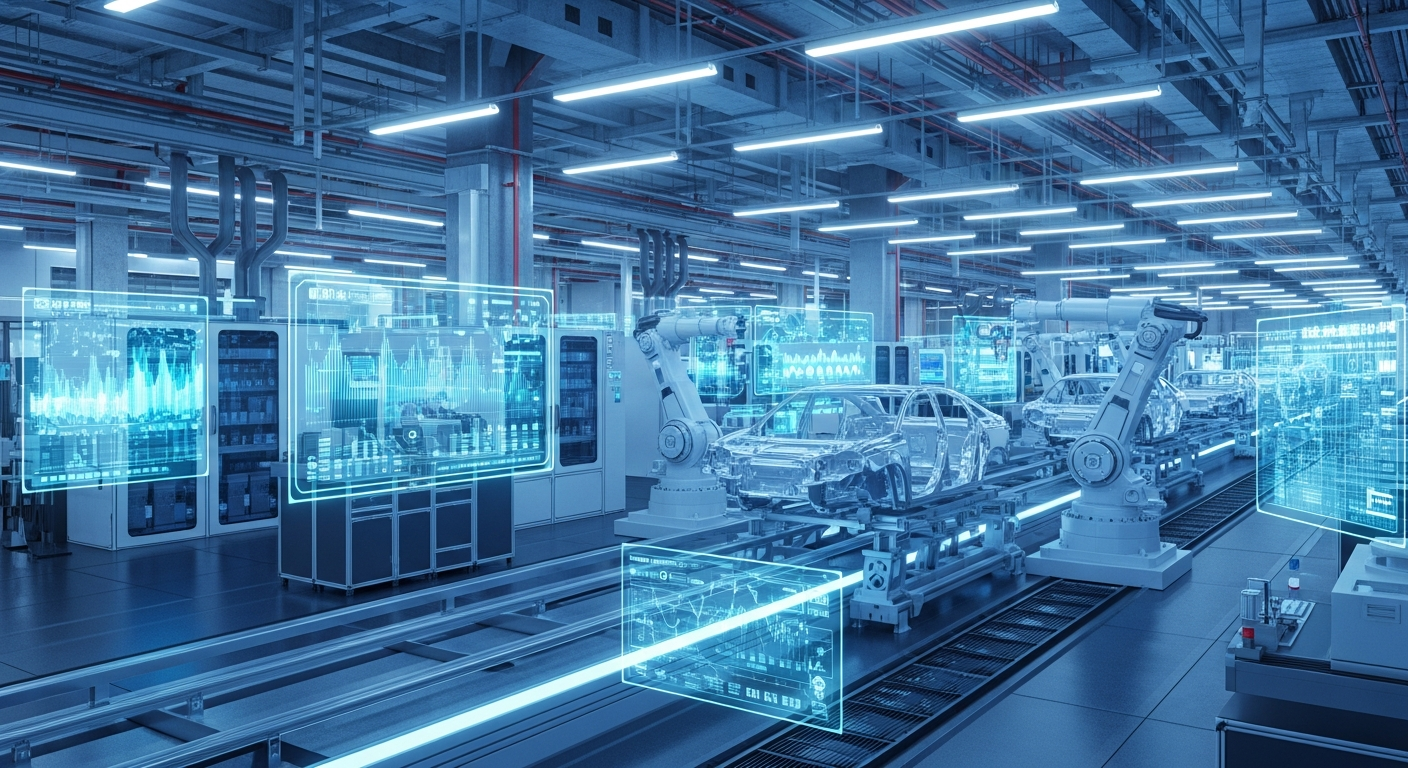



The Future of Automotive Production: Automation, Robotics, and Smart Factory.
The automotive production sector is quickly changing because of the development of automation, robotization, and intelligent factory systems. The traditional production lines are being transformed into highly efficient, intelligent and interconnected systems due to these innovations. Manufacturers are currently turning their attention to enhancing productivity, cutting down operations cost, and upholding quality and standard of operations besides attaining sustainability targets. The combination of artificial intelligence, Internet of Things (IoT), and new-fangled robotics make automotive production smarter and more versatile than ever.
Emergence of Automation in the auto industry.
Automation is now an inherent part of the new production in the motor industry. It substitutes the tedious manual operations with machine-based operations that enable the factories to work more consistently and more accurately. There are automated systems used extensively in welding, painting, assembly and also in inspection.
Automation is very efficient in that it can produce in a continuous manner without exhaustion. It leads to better output and minimized time of production. It also improves the quality control by reducing human error and bringing about a standardized approach to all units.
Use of Robotics in Production.
Robotics is a very important tool for changing automotive manufacturing into a very advanced and efficient industry. The industrial robots of today can undertake complex work at a great rate with precision.
Robots (also called collaborative robots) are intended to be used in cooperation with human laborers. These robots are used in different applications like assembly, handling of materials and checking which enhance productivity and safety at the workplace. Robotics is also bringing about flexibility in the manufacturing lines so that they can quickly adapt to various models of vehicles and manufacturing needs.
Smart Factory Integration
The future of the automotive manufacturing industry is smart factories. The connection systems and IoT devices used in these factories, as well as AI-based technologies, are aimed at the creation of intelligent self-optimizing production environments.
IoT helps to establish real-time communication between machines and lets manufacturers monitor the work and identify problems in real-time. This connection assists in predictive maintenance that lowers the incidental downtime and enhances efficiency.
Artificial intelligence also strengthens the manufacturing since it can analyze large amounts of data. It aids in optimization of work processes, forecasting of equipment malfunctions, and enhancing quality of products. Another way in which digital twin technology can be used is to provide manufacturers with the possibility to make virtual prototypes of production systems, allowing them to test them and optimize them without disturbing the real production process.
Sustainability in Auto-Production.
Sustainability is one of the major concerns in contemporary automotive manufacturing. The development of the modern technologies in manufacturing enables to decrease the effects on the environment, maximizing the use of energy and reducing waste.
Energy consumption can be monitored and controlled by smart systems so that efficiency of machines can be observed. Moreover, accurate automation lowers the amount of waste materials used in the production process. Most manufacturers are also using environmentally friendly materials and recycling to contribute to eco-friendly development.
Smart Factories Cybersecurity.
Cybersecurity is becoming more critical as the process of manufacturing becomes digital and interconnected. To avoid cyber threats, it is necessary to protect sensitive production information and industrial systems.
To protect their operations, manufacturers are installing new security platforms, such as encryption and secure communication channels. Cybersecurity AI tools are also applied to detect and reply to threats in real time, which ensures continuous and uninterrupted production process.
Major Tendencies in Automotive Production.
The use of automation and robotics in manufacturing is increasing. Smart factory systems are likely to keep growing, thanks to the Internet of Things and artificial intelligence. In addition, the use of data-driven decision-making is becoming more common.
- Emphasize on green and eco-friendly production.
- High-priority on cybersecurity and protection of data.
Future Outlook
The future of automotive manufacturing will be characterized by fully automated intelligent and connected systems. Factories will be more autonomous hence needing less human intervention and with high efficiency and precision.
The use of AI and robotics will keep on improving and companies will be able to create customized vehicles in large volumes. Simultaneously, sustainability and e-evolution will be the key to the development of the industry. With these technologies, firms that embrace them will have an edge in the rapidly changing global market.
Conclusion
The car manufacturing sector is experiencing a significant shift that is brought about by automation, robotization, and smart factory integration. These technologies are enhancing efficiency, improving product quality and making the production practices more sustainable. With the rate of innovation growing faster, the future of the automotive manufacturing industry will be characterized by smart, networked and highly efficient systems that will transform the face of automotive globally.
Often asked questions (F&Q).
1. What is roboticization in car manufacturing?
Automation is the application of machines and technology in the production process with the least human intervention so as to enhance efficiency and consistency.
2. What are the advantages of robotics in the manufacturing industry?
Robotics enhances the manufacturing process by making it faster, more precise, and with fewer mistakes and allows automation of the complicated tasks.
3. What is a smart factory?
A smart factory represents a connected system, IoT devices, and artificial intelligence-based production environment allowing to establish an efficient, data-driven, and automated environment.
4. The question is, why is sustainability in automotive manufacturing important?
Sustainability will aid in minimizing environmental effects, energy conservation, and environmentally friendly production methods.
5. What is the benefit of AI to manufacturing processes?
Data analyses by AI are aimed at streamlining the manufacturing process, maintenance planning, enhancing quality, and aiding in decision-making.