








Your Next Car Will be Driven by AI, not by fuel only – How Smart Technology is redefining the future of Driving in 2026.
2026 AI Revolution in Modern Cars.
- Adaptive Driving Assistance Systems.
- Autonomous Driving Capabilities
- Personalized In-Car Experience
- Predictive Maintenance Technology
- Connected Vehicle Ecosystem
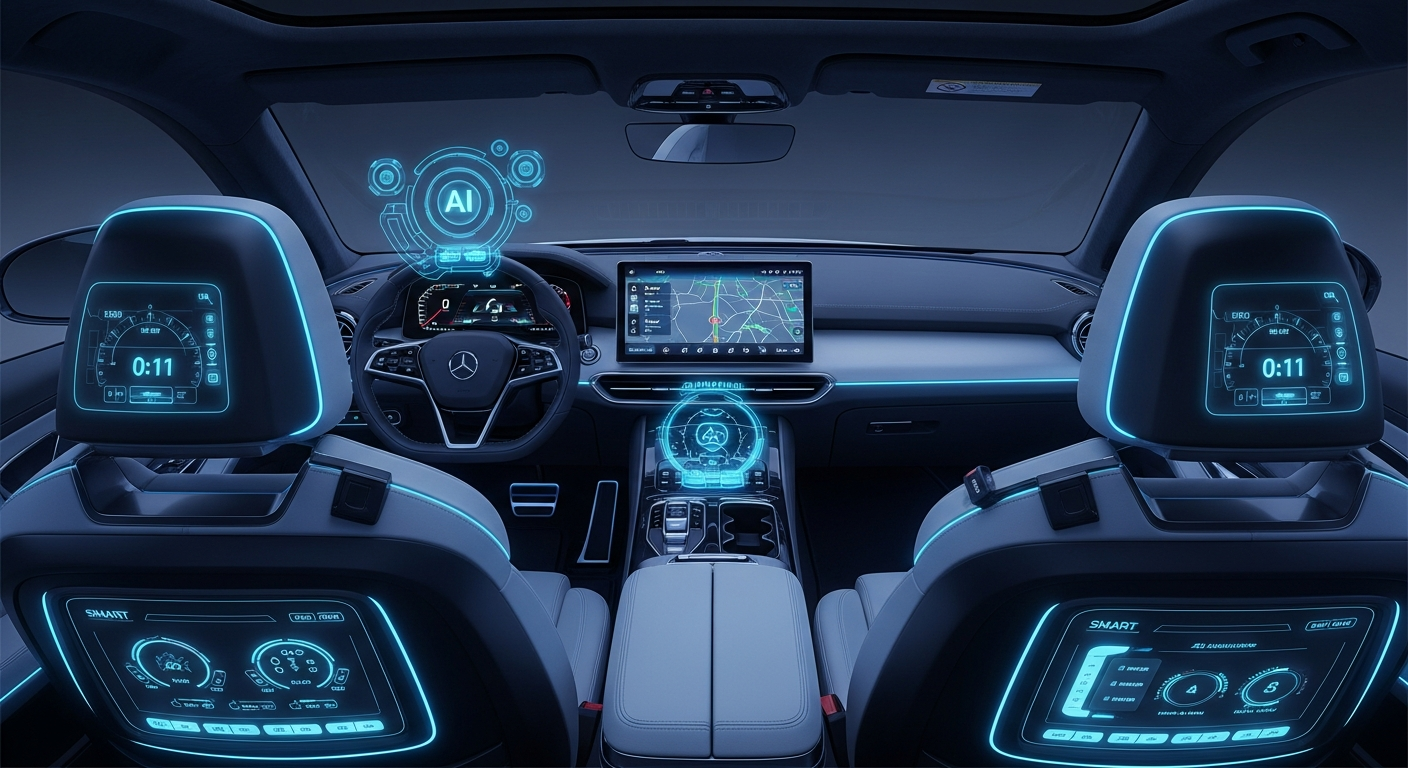
The cars of 2026 are becoming extremely intelligent devices as opposed to mere transport machines. Cars have become highly automated and think, learn and react to real world situations using AI. Driving is becoming safer, smarter and efficient to the everyday users with this shift.
Adaptation Driving Assistance.
The current AI-driven driving assistance systems are very well developed and sensitive. The systems assist drivers in steering, braking, and detecting lanes as well as adjusting speed according to the conditions on the road. During rush hours or unforeseeable situations, the AI will minimize stressful situations by taking fast decisions that contribute to safer driving. This type of technology will go a long way in minimizing human error since they are the greatest contributors of road accidents.
Self-driving abilities.
By 2026, the level of maturity of self-driving technology has advanced. Cars are now able to drive on the highway, city streets and car parks with very minimal human intervention. Tesla and Mercedes-Benz companies are not the last in pursuing this innovation and are training their AI models on billions of kilometers of driving data. Though full autonomy is still being developed, semi-autonomous systems are already being developed and are becoming more and more popular on a yearly basis.
Customized in-Car experience.
AI is turning each voyage into a one-of-a-kind and comfortable experience. Cars today will know who is driving and will automatically adjust the seat position, climate, lighting and entertainment to the likes of the driver. The voice assistants have also mastered the natural language and, therefore, drivers can operate navigation and media without being distracted. This brings more of a human factor of interaction between the machine and the driver.
Predictive Maintenance Technology.
Predictive maintenance is one of the most helpful AI functions in modern cars. Sensors are continuously used to keep track of the vehicle health, such as engine performance, battery status and tire pressure. This data is analysed by AI systems and warns drivers in case of a failure. This prevents the surprise breakdowns, minimizes the costs of repairing and increases the life of the vehicle.
Integrated Vehicle Ecosystem.
Cars have become the means of a completely interconnected digital ecosystem. They exchange information with other cars, road signs, and intelligent infrastructure on-the-fly. This interconnectivity will aid in optimizing the traffic flow, minimize congestions, and enhance efficiency of the routes. It also allows safer driving as the information on road hazards is shared in real-time between vehicles.
Hypersmart Mobility and the Future Transportation Systems.
- AI-Based Safety Innovation
- Electric Vehicle Intelligence
- Intelligent Traffic System.
- Cybersecurity and Data Protection.
- Autonomous Transport Networks represent the future of transportation.
- Future of Autonomous Transport Networks
A new transportation system is being re-designed based on AI and connectivity. Cars are no longer single entities, but they belong to a bigger smart mobility system that is able to communicate, learn and adapt.
Safety Innovation of AI.
AI has vastly enhanced the safety systems in vehicles. Even the cars today are able to identify pedestrians, animals and obstacles within milliseconds. High level predictive algorithms are used to detect road patterns in order to avert accidents even before they happen. This is real-time decision making which is making roads safer than ever before.
Vehicle Intelligence EV.
EVs are getting smarter by incorporation of AI. Systems maximize the use of batteries, control the charging process, and forecast the energy consumption. Such businesses as BMW are applying AI to enhance the efficiency of EVs and minimize the impact on the environment. Smart charging systems can also assist its users to save money by planning charging during the low-demand hours.
Traffic Integration of Smart City.
AI is having a major role in the development of smart cities. Traffic lights, road sensors and vehicles are presently collaborating to maintain traffic flow. This saves a lot of time in terms of congestion and traveling. The real time information enables the navigation systems to propose more efficient and fast routes.
Information Assurance and Security.
With the increased interconnection of cars, cybersecurity is of great significance. The AI-powered cars have access to extensive personal and geographic information, and therefore, can be hacked. Producers are putting a lot of money on encryption systems and safe communication to safeguard information and make sure that the users are safe.
Autonomous Transport Network Future.
The future of transportation is shifting to complete autonomous networks in which AI controls the whole traffic systems. There will be cars, buses and logistics vehicles which will run in harmony with city infrastructure. The driving will be substituted with the AI-controlled mobility systems, which will enhance efficiency and decrease accidents.
Conclusion
In 2026, the automotive industry will be totally transformed by AI. Cars are not only a mechanical tool anymore but they are intelligent and able to learn, adapt and make decisions. As manufacturers such as Tesla, BMW, and Mercedes-Benz pioneer the transportation sector, transportation is becoming safer, smarter and more connected than ever.
In the next few years, the act of driving will not be done manually, but rather through intelligent supervision as most of the complex decisions will be done by AI. Cars are not the only things that are evolving in this manner, the very notion of mobility is being redefined.
Frequently Asked Question (FAQ).
1. What is AI in contemporary automobiles?
Modern cars AI can be described as intelligent systems that enable cars to analyze, make decisions and assist drivers in driving, safety, and performance.
2. Will AI-controlled cars be completely autonomous in 2026?
Not fully. The majority of vehicles remain semi-autonomous, but a full autonomous system is quickly being invented.
3. What are the AI cars market leaders?
Tesla, BMW and Mercedes-Benz are prime examples of companies that are at the forefront of AI innovation in the automotive industry.
4. What is the way AI is helping people to be safer on the roads?
By identifying the hazards in time, anticipating accidents, and providing the motorists with immediate remedial measures, AI enhances their safety.
5. Will AI be able to drive human drivers out of business?
In the future, AI has the potential to replace most of the driving functions but it will not be completely replaced without legal, ethical and technological advances.